
Life in the Laundromat Lane
By Jeff Moak


I’m happy to be writing my first column for Fabricare Canada magazine. To kick off the new year, I want to reflect on how the industry has evolved through a technology lens, shaped by growing up in laundromats with my grandfather.
John (Arjen) Brandse (a.k.a, Bub) came to Canada after WWII with my grandmother and their two young children. Bub had an entrepreneurial spirit before that word gained so much popularity. He owned his first laundromat in the late 1960s; it was all top-load washers and dryers with standing pilot lights.
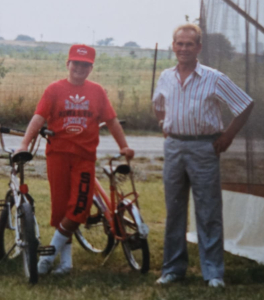
I was 9 years old when I took on the role of Bub’s ‘bagman’ carrying all those heavy bags of quarters to the bank for deposit. As I got older, I started to help Bub out with the store in other ways. I would go in if the change machine needed to be reprogrammed or if he needed to change a price on the vending machine. When Bub started to semi-retire, going on vacation with my grandmother, the store was mine to take care of.
A Better System
The store has two entry doors. One opened automatically at 5:00 a.m., with a sign letting customers know. The other had no automation at all and had to be locked and unlocked manually. Closing at night meant cleaning the store, locking one door with a key, then walking across to the other to engage a mechanical timer so it would unlock again the next morning. It worked, but it was not a great solution, and I found myself asking the same questions even then – “Why do we only have one, why not two, and why can’t it just lock itself?” That’s when I knew: there had to be a better system.
Part of my job was to collect and count coins. At first it was quarters only, until 1987 when loonies appeared. The loonie made it easier for the customer to pay for the machine, but we now had both quarters and loonies to separate and count. Great fun! As washers were replaced, coin slides disappeared and were replaced with coin drops, the next evolution in payments.
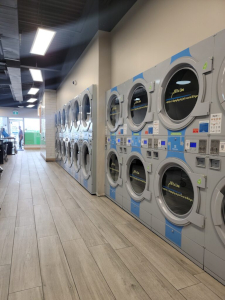
In 2003, I purchased Bub’s last store from him and that became my first store. I replaced the manual door lock right off the bat, and the auto-open-only door with new door strikes and a timer that would now lock and unlock the doors. This was something important to a 25-year-old who liked to go out at night. I also kicked the last top loaders to the curb. Bub was pretty good at replacing and updating his equipment, but he always held on to a few top loaders. To me they were old technology.
From 2003 until 2010, I kept the same equipment – a mix of newer Maytag front-load washers, plus some older Wascomat front loads (Junior W74 and 124s with coin slides, of course). The turning point came in 2010 when I decided to update the store’s equipment, replacing everything over the next few years with just one brand and series.
New Equipment
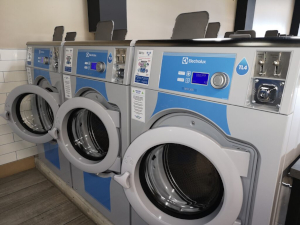
The new washers and dryers were all Electrolux, a brand reintroduced back into North America. So many customers mentioned they knew the vacuum cleaners. The newer equipment had a slick dial to adjust the cycle, and a new display: it told you the cycle and the price – it even had chargeable, add-on options. Even better, the machines would weigh what was inside and measure the amount of water needed. Did that cause issues? Oh yeah, over-sudsing, definitely! Customers would comment, “There’s not enough water,” but it saved a lot on utilities, and customers got used to it. We also introduced cycle-based pricing, and charged more for hot washes than cold; customers got used to that, too.
The one thing that didn’t change was coin collection: sorting quarters, loonies, and refilling the change machine. It took me a while, but in 2019 we introduced an alternative way to pay for machines through an app in our second store (which was purchased and retooled in 2018). With that change came new insights into our business – we could see sales data, know when a machine went out of service, change pricing, and even start machines remotely. Much later than I wanted, and several years after introducing app payments in our second location.

Updated Payment System
The bigger change, and the one that had the most positive impact on our operations, came shortly after introducing app payments in store two. In 2020, we started using CleanCloud, a point-of-sale system for wash-and-fold operations in our second store, and a year later, we rolled it out in store one. The final piece came in 2024, when we added Tangerpay – the payment system I mentioned earlier – to our first store. With Tangerpay integrated into our POS, staff could now start machines directly through the POS without using coins or a separate app. Integration like this has become far more prevalent across the industry, and for us, it has made managing our staff and wash-and-fold business significantly simpler.
I look back over the years, and I see a constant progression in the technology we use. Door locks now connected to your loyalty card readers; ozone and direct injection – once common in industrial plants, now becoming popular in vended laundromats; payment systems (whether hybrid or full coinless) are now everywhere. Each time a new technology is introduced, there is push back by some, but it enables us as store owners to make data-driven decisions, to better serve our customers and shift where we spend our time.
I often wonder what Bub would think if he could see the technology in his store today and, as I look forward to what the future will bring, the question is, what’s next for tech in our industry?
Related Posts


About The Author

Jeff Moak
Jeff Moak is a third-generation laundry operator with hands-on experience across self-serve, wash & fold, and pickup & delivery. He operates Super Clean Laundromat, leads Saaf – Laundry Delivered, and founded Claro – Modern Laundry Solutions, providing equipment distribution and consulting services to operators. Jeff regularly speaks at industry events, sharing practical insights from the operator’s perspective. You can reach him at jeff@supercleanlaundromat.ca.