
Anyone Can Wash Clothes—Professionals Process Them
By Kevin Marois

The theme this month is liquids. Rather than giving you a sales pitch on our detergent line, I thought I’d give you a few things to consider in your laundry department. You run a professional laundry—it’s time to start thinking like a professional. Commercial laundry is your business.
Hardmount Washers
Hardmount washers were the standard 30 years ago and we still have people asking for them. That may not be the best technology for your situation.
A hardmount washer has a rigid steel base that needs to be anchored securely to a thick concrete base. The concrete needs to be thick because the forces during extraction are transferred to that base.
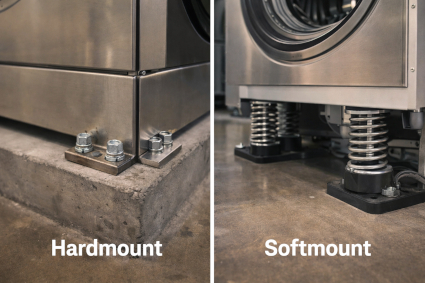
The newer models of washers are Softmount. They use springs and shock absorbers to absorb the vibrations/forces during extract. Softmount washers can sit on rubber feet without even being anchored. They usually have extract forces of 400 Gs while a hardmount washer is probably around 200 Gs. The more water you can extract, the shorter your drying time will be. Softmount washers generally offer more versatile computer controls.
Softmount machines cost more money, but when you include the cost of installation, the difference is not that great. It’s time you caught up with technology.
A Shorter Cycle
We get calls sometimes from customers wanting a shorter cycle on their washer. Sure, we can program that washer. But what do you want the cycle to be? They ask for a wash cycle that is 20-25 minutes long.
OK, but do you want the goods to come out clean? We normally program three rinses when we are using commercial grade detergents. A rinse takes 2-3 minutes, plus a minute to fill and a minute to drain. You just used 15 minutes out of your 20 minute cycle.
We can’t beat physics. If you want clean laundry, it takes time. Water has to penetrate fibers. Detergents take time to work. Mechanical action is required to loosen and remove the soil. You might run something through your washer in 20 minutes but you are not getting it clean. Quality cleaning takes time. Add more equipment or change your schedule so that you have time to produce work that you are proud of.
Professional Laundry
We need to pay attention to the terminology that we are using. Yes, you are processing garments with water—but that doesn’t mean you are simply “washing” them. Anyone can do washing at home, so why should they take it to you?
You process garments using a commercial laundry process. This means commercial laundry equipment, industrial laundry detergents and trained professional staff members who understand the processes they are using. Professionals understand the limitations of the garments and equipment they are using. They use a process that is best suited to a particular type of fabric and soil that is on it.
What about Wash-and-Fold? Is that the same as household wash? You should still be using commercial products that disinfect and preserve the life of the textiles. Use terminology that makes it clear that you are a professional.
Training
We recently had a call about a dry cleaning machine that wasn’t drying properly. The issue was actually that the boiler wasn’t getting above 30 PSI. It normally operates at 100 PSI.
We checked all the usual things but were still having issues. The boiler would foam up and carry all the water into the plant. Then it would shut off, until the pump refilled the boiler. We drained the water out of the boiler and filled it with fresh water. It was running fine and that should have been the end of it.
They called back the next day—same problem. This time the boiler was foaming up even worse. Eventually we tracked down the issue: they were putting Spot Buster into the return tank, thinking it was boiler treatment. It came in an unlabeled cardboard box, and they simply started using it.
I don’t bring this up to mock the lady who put that product in the return tank. I bring it up to point out a management problem. That owner/manager should have been aware that their staff member could not read English. They should have had safeguards in place to protect her, the equipment and customers’ garments. It is obvious now that she cannot read English. Management failed her and she could have been hurt.
Do you know your people’s capabilities and what are you doing to help them? Our industry often employs people whose first language is not English. You have dangerous equipment and chemicals in your laundry department. How are you managing that risk?
Hot Water
There is something about water heaters and dry cleaners. We have 8 or 10 customers who do not have hot water in their plant. No hot water for laundry. No hot water even for the bathroom. But they don’t want to fix their water heater. I don’t understand it. Yes, you can wash in cold water. But our water is 45F in the wintertime. A little hot water makes everything work much better. You are stepping over dollars to pick up pennies.
Water Softeners
When I first got into the industry, people would ask about water softeners. We have hard water in Calgary, so you have to do something. Water softeners are expensive. The choice was presented—buy a water softener or just plan to use more detergent.
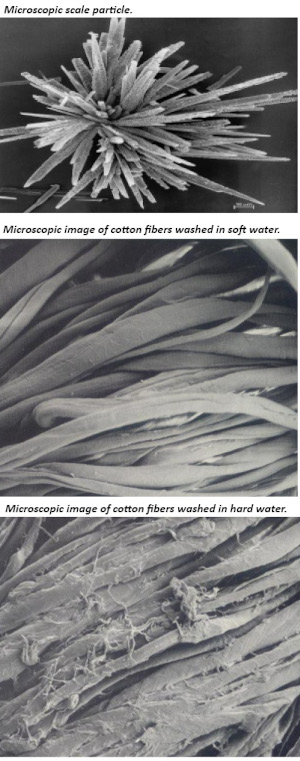
Using hard water and more detergent creates soap scum and causes greying on fabrics. Even worse than that, hard water causes additional wear on the fabric. This photo shows a microscopic crystal of minerals. That is the Calcium hardness in your water.
The next two photos show cotton fibers that have been washed in soft water vs in hard water. Note the damage on the fibers that occurred from one wash. Hard water causes additional wear on the fibers. To do quality laundry, you need soft water.
Anyone can wash things at home, but you are a trained professional doing commercial laundry.
Think like a professional.
Related Posts


About The Author

Kevin Marois
Kevin Marois founded Calgary-based Integrity Mechanical in 2003 to serve plants in Western Canada. He writes on issues related to equipment, its purchase, maintenance and use. You can reach Kevin at imi@telus.net, or via his website, www.imicanada.ca.