Do You Know What You’re Doing?
The equipment can’t run itself, and neither can your business
By Becca Anderson
Tell me, when did you last train someone? Really train them, not just show a new employee what button to push. Not have them shadow Mary for two shifts. Not tell them, “You’ll pick it up.”
Actually train them.
The hard truth is that you can spend a fortune on a plant and the equipment inside it, but if the people running it aren’t trained, your results will be mediocre, at best.
Let’s look at where you can get the training you need. Much of it does not require your personnel to even leave the premises. Other courses are intensive and at another location. A blend of both is probably best for most companies.
Start At the Beginning
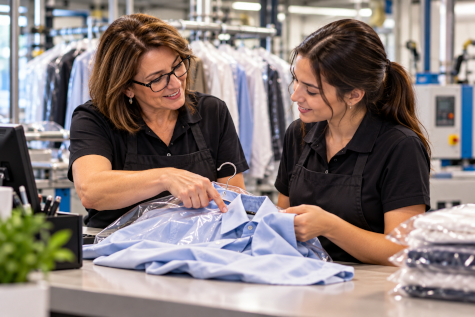
Your front counter staff are pivotal to your overall success. Many companies give younger job seekers a shot at these jobs, put them behind the counter, and do little to make them feel they know what they are to do. Is it any wonder the roster up front is a revolving door?
A person who is thoroughly briefed on responsibilities, authority range, and the procedures within the plant will exude confidence and competence at the counter. Your customers will react positively to handing their garments to someone like that. This key role can make or break your company. Train them accordingly.
Over the Counter
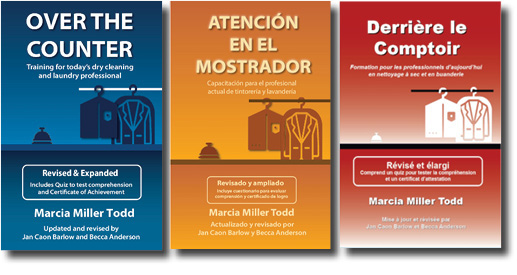
Finding training for Customer Service Representatives (CSRs) has been hit or miss for many years. Industry expert Marcia Todd (publisher emeritus of this magazine) wrote a series of columns in the 1980s that were combined into a book of practical wisdom and training for CSRs. The book has now been updated, expanded, and translated into Spanish and French, as well as being available in English.
Chapters include Greeting Customers, Handling Incoming Garments, Upselling, Handling Complaints, dealing with the phone/texts/email, Problem Customers, and Remembering Names. These are standard topics in such training. But it goes beyond that to the everyday friction points in the job with chapters on Teamwork at the Counter, Getting Along with Others, grooming, answering tough questions, and working in concert with the whole plant to get the job done.
Discussion points follow each short chapter, with a comprehensive quiz at the end of the book, and a Certificate of Achievement to inspire confidence. The books are available on Amazon as both paperback and eBook, via links from our website.
Formal Training

The Dry Cleaning & Laundry Institute (DLI) has in-person Introduction and Advanced Drycleaning courses, live virtual stain-removal courses, leadership and customer-service training, self-paced courses and certification programs.

They’ve also introduced custom on-site training, where an instructor goes into an individual plant and works with employees on that plant’s equipment and problems. Topics can include stain removal, finishing, customer service, dry cleaning, wet cleaning, shirt laundry, wedding gowns, management and marketing, and CSR training.

CLA has a broad education program for self-service laundry operators. They run free monthly webinars covering things such as wash-dry-fold, marketing, employee management, pickup and delivery, attendant training, leases and equipment maintenance. They also offer “How to Start a Laundromat” webinars and live workshops, plus their larger WDF Workshop.
CLA also works with Laundry University to provide laundromat training programs, employee onboarding and business management courses.
The organization’s Full Cycle podcasts are very operator-oriented: buying and building laundromats, service and maintenance, WDF, investment, technology, community involvement, etc. The channel is quite active, with new episodes appearing all the time. Many involve current operators talking about their successes and challenges in realistic and practical terms.

TRSA (“the Association for Linen, Uniform and Facility Services Industry”) addresses the industrial/commercial laundry segment.

Their Certified Production Laundry Manager (CPLM) program covers laundry production management, and there’s a self-study route as well as preparation through the Production Management Institute. The training materials include 20 production videos covering sorting, washing, drying, finishing and pack-out in industrial, healthcare, food-and-beverage and hospitality laundry operations. It also includes management material on communication, conflict resolution, hiring, safety and employee supervision.
TRSA also has a current LevelUp Laundry Supervisory Skills Training Program, plus webinars and virtual education. After all, training isn’t just for the person operating equipment. Moving a good production employee into supervision requires another whole set of skills, and this training addresses that.
The Association for Linen Management (ALM) has online courses, webinars, textbooks, certifications and in-person training through their Laundry & Linen College. Programs range from Certified Washroom Technician — aimed at front-line employees who may move into leadership — through Certified Laundry and Linen Manager and Registered Laundry and Linen Director.
The Laundry & Linen College gets into some fairly serious plant subjects: equipment and maintenance, production standards and efficiency, chemistry and the wash process, energy management, safety, textiles, linen management and infection control.
The association’s training demonstrates a career ladder approach. From employee to technician to supervisor/manager to director. Training doesn’t have to be one course someone takes when they’re hired, but rather a systematic flow of training throughout a career.
Associations and Suppliers Have Training

Equipment, chemical and systems suppliers frequently train customers in the use of what they’ve purchased. (For example, Miele specifically talks about support during installation, training and service for professional laundry customers, and it has demonstrated WetCare/wet cleaning techniques in various open house situations.)
Industry associations that hold regular conferences frequently have specific training available during those events. The Canadian Fabricare Association CleanExpo convention (November 13-14 in Toronto) will have multiple learning opportunities, as well as live equipment demonstrations.
Of course, it goes without saying that the Clean Show (July 15-18, 2027) will have over 30 hours of educational seminars on all branches of the industry.
Regional associations throughout the U.S. also hold conventions, seminars and other educational events. Check what’s available in your area, including:
- Southwest Drycleaners Association (SDA) — A “super association” that has expanded significantly following mergers, representing over 10 states and hosting major regional equipment showcases.
- Heartland Fabricare Association (HFA) — Formed by a merger of several midwest associations into an eight-state organization, and having events and education available.
- Western Fabricare Association (WFA) — Provides educational seminars, compliance guidance, networking events, and government advocacy for the West Coast region.
- South Eastern Fabricare Association (SEFA) — Provides seminars, workshops, technical training and educational programs.
- MidAtlantic Association of Cleaners (MAC) — Supports operational education, regulatory compliance, and community building across the mid-Atlantic corridor.
- North East Fabricare Association (NEFA) — Represents a broad coalition of New England and mid-Atlantic professional fabricare businesses.
- California Cleaners Association (CCA) — Represents independent and localized dry cleaning segments across California.
- North Carolina Association of Launderers and Cleaners (NCALC) — Coordinates directly with state regulatory entitities specifically for North Carolina operations.

America’s Best Cleaners offers a team of consultants who work with both ABC Affiliates and non-affiliated businesses to assist owners, managers and team members achieve professional and personal success. ABC offers CoutureCare© Certification. ABC members-only events include in-depth study of each attendee’s company performance, visitation at host plants, etc.
Podcasts and Online Informal Learning

In addition to CLA’s Full Cycle active podcast program, other podcasts and web-based interactions can add to your understanding of the industry and specific issues you deal with daily.
Cleaner Conversations — Brand new in 2026. Covers both dry cleaning and laundromats. The two hosts interview operators and industry people about how they built their businesses, operations, marketing, technology and management. Popular industry members like Chris White, Kermit Engh, Dave Coyle, Ryan Fish, Peter Blake, Nicole Kirby, Jan Barlow and others have been featured. There are roughly 20+ episodes archived so far.
The American Drycleaner Podcast — A dry cleaning podcast. Fifty episodes in the archive, covering spotting, finishing, boilers, automation, customer service, pricing, hiring, succession, plant construction, safety and so forth. The latest episode is from August 2024, but the archive is still useful.
Laundromat Resource Podcast — Jordan Berry’s show. The archive includes more than 300 episodes, and it’s still active. Very heavily geared toward laundromat ownership: buying stores, financing, equipment, technology, marketing, profitability and interviews with successful operators.
Laundry Nerd Podcast — From Alliance Laundry Systems. Topics include ownership, technology, operations, ROI, payment systems, quality, maintenance and interviews with operators and industry people. About 66 episodes so far.
The Laundromat Millionaire Show — Dave and Carla Menz. Another substantial archive, with 126 episodes (and growing) covering laundromats, WDF, pickup and delivery, staffing, marketing, acquisitions, pricing, scaling and general business management.
TRSA’s Linen, Uniform & Facility Services Podcast — Has 85 episodes so far. Subjects are appropriate to larger operations: leadership development, healthcare, M&A, workforce issues, industry trends and commercial laundry management.
Facebook Groups

And don’t dismiss social media as education. Industry-specific Facebook groups let cleaners and laundry operators post a problem (like a troublesome stain, an equipment issue, a pricing question or an employee dilemma) and tap into the collective experience of hundreds or even thousands of people who have probably faced it before. Just do a search on Facebook with terms like “dry cleaner group” or “laundromat owners”, etc.
DLI, Cleaner & Launderer, CLA’s Laundromat Professionals Network, The Route Pros and Maverick Drycleaners are all active in this space, as well.
It’s a New World
Many of these educational options did not exist when the majority of our industry’s members started their careers, or even 15 years ago, to be honest. Keeping up with what’s available will broaden your approach to making sure you and your staff are thoroughly trained.
And yes, I said YOU. Don’t assume you already know everything because your name is on the door. Conferences, webinars, peer groups, certification programs and supplier training are for you, too.
Training often costs money.
So do ruined garments, re-cleans, broken equipment, lost customers, injured employees and people who quit because nobody ever showed them how to do the job properly.
When you look at the two sets of costs, training is far less expensive than a business that never prospers as it could, if it took training seriously.
Looking for upcoming training? Check Fabricare Canada’s Conferences & Events Page regularly for industry classes, workshops, conferences and educational opportunities.
Related Posts


About The Author

Editor, Fabricare Canada magazine
Becca Anderson spent 17 years in public relations, advertising and corporate PR before joining Fabricare Canada in 2000. She was named editor in 2013, and welcomes feedback about the magazine via the contact form on this site.