More than just Social
Making an excellent social media post

SERIES: Social Media Stars
By Becca Anderson
In the first installment of this series, I talked about how website searches and rankings have changed drastically in the last few years as AI has become more involved. In the same way, the value and viewability of your social media posts has also evolved from the quest for being viral, to a demand for understanding.
Modern social platforms (Facebook, Instagram, LinkedIn, X, and even Google Business) now rely heavily on content understanding, not just engagement spikes. They analyze what the post is about, who it is for, whether it teaches or reassures or informs, and whether viewers stay and read or save it. This is a much more comprehensive way to look at posts, and is actually a benefit to you as a business owner.

In the past, it was all about how many clicks or “likes” you got that determined success. But just because you said or did something clever and posted it, didn’t necessarily translate into sales. That’s why a lot of companies just dismissed getting involved in the social media space—it was just about superficial reactions.
Now, with AI looking much deeper, you have the opportunity to rise to the top by having posts that are useful, clear and relevant to everyday life. These are actually things that move the needle for a customer, from just being amused to saying, “I think I’d like to try this dry cleaner next time.” If you feed their need to know important information, you’ve hit the bullseye.
Clarity beats Cleverness (again)
The problem with basing your social media posts around humor is that lots of people don’t “get” inside jokes. They don’t understand vague captions. You blend in with everyone else who is still chasing those “likes” and you lose an opportunity to truly communicate. Trend-chasing without content is a waste of effort.

The best business posts include direct statements, clear visuals and plain explanations. That doesn’t mean you can’t build in personality and gentle humor, but the goal is communication. Compare these two potential posts and see which fits the dynamic just described:
“Monday mood ”
“Oil stains spread quickly. Blot—don’t rub—and bring the garment in as soon as possible.”
One just says what a lot of other posts will be saying on a Monday, and actually conveys that you don’t want to be at work, don’t want to be handling customer orders, and might be grouchy to deal with!
The other seeks to educate the customer, positions you as an expert with specific advice, and is likely to get saved and shared. It will also be positively viewed by search engines and AI when people ask for a good dry cleaner in their area.
Every post should do one job well
We like to think that multi-tasking is actually something that’s possible, but it’s not—at least, not if you expect to do both things well. Instead, truly successful people do one thing at a time and pour all their energy and creativity into it. When it’s finished, they move on to something else.
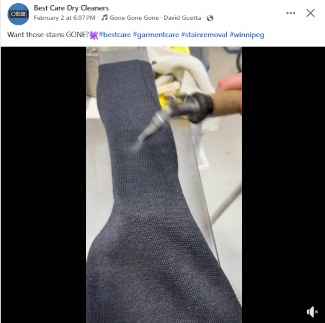
Social media posts are the same. Don’t view it as a way to dump huge amounts of data (like price lists or long lists of services or similar information) in front of readers. Watch someone scroll through social media sometime. That thumb just keeps flicking along and rarely stops. They won’t see that long post.
High-performing posts do one of the following:
- Educate
- Reassure
- Explain
- Remind
- Humanize
Posts that try to do all five usually do none.
Focusing in on a particular job for a social media post takes a lot of the guesswork out of how to structure it. Let’s look at how each one can be accomplished in a post:
Educate — “To you, it’s a red wine stain. To us, it’s sugar and alcohol and other components. Let us handle it. We’ve been doing it successfully for years.”
Reassure — “We know you’re busy. We’ll let you know the moment your order is ready.”
Explain — “Your garments go through a three-point inspection before they ever reach the dry cleaning machine, so we catch the stains, needed repairs and special treatments needed.”
Remind — “We’ll be closing at noon on December 24, so pick up your party clothes early.”
Humanize — “Our finishing expert Holly just returned from a two-week training course. She’s eager to put all she learned to work for you!”
The point is that you need to select an approach for each post, and then be intentional in crafting the post to achieve it. Over time, post by post, you’ll build credibility, trust and loyalty.
Expertise over Promotion
AI and search engines now downgrade posts that are full of sales language, repetitive promotions or posts that say “20% OFF!” without any context of what is being referenced. On the other hand, they reward posts that demonstrate knowledge, give process explanations, and speak with calm authority.
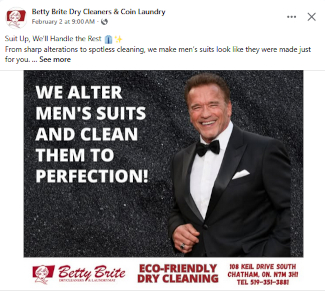
You possess a wealth of knowledge your customers don’t! You know about fabrics, understand the fabricare processes, and have stain-removal expertise. Share that knowledge in posts in a way that shows what you know, rather than advertising it. For instance:
“We inspect every silk garment before cleaning because dyes can migrate differently depending on weave.”
A post like that is marketing, without sounding like it. It gives customers the idea that your really know know your way around different fabrics, and reminds them they don’t know what you know. That moves them to bring things to you, rather than try to clean them at home with potentially disastrous results.
Understandable in One Second
Think back to watching someone on social media on their phone again. They rarely pause, they scan quickly. To capture their attention, your message needs to be understandable in just one second.
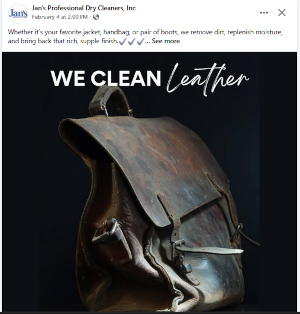
How do you do that? You use the post to show one clear subject. Avoid clutter in the design. Don’t rely on tiny text (which gets tinier on phone screens). Your message should make sense without sound, since people often scroll through social media in settings where they have their phones muted.
Different platforms respond better to different kinds of posts. Focus on clarity, but tailor to the platform.
- Instagram/Facebook—clean photos, minimal overlays
- Tik-Tok/Reels—clips of processes, hands working, before/after
- LinkedIn—staff featured, professionalism, operations
- Google Business posts—informational, practical, local
Meaningful captions, not filler
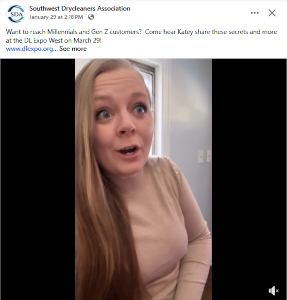
Platforms increasingly parse caption text to understand the topic, the audience it’s aimed at, and the intent of the message. Depending on how it reads your captions, you may or may not be recommended to a person searching. While hashtags were “the thing” for years, they matter far less than plain language.
Keep captions contained to short paragraphs. Use complete sentences and natural phrasing. Give real explanations to real potential questions from your customers. This kind of captioning is easier for both the reader and the AI/search engines to digest.
“Heat can permanently set protein stains like blood or sweat. Cold water keeps them removable.”
That sentence may surface in search or AI summaries later, and your post will be where they point.
Consistency beats Frequency

Many marketing experts advise companies to post daily material. For some, that results in running out of ideas and falling back on the funny or uncommunicative posts just to meet the quota. Posting daily is far less important than posting predictably.
For a dry cleaner or laundry, that can mean 1-3 thoughtful posts per week, using a recognizable tone and repeating the same helpful themes over time.
Over time, as you post, the algorithms learn who your audience is, what you usually talk about, and when your posts are relevant. That makes it easier for them to recommend your business when people search. The search engines and AI are always learning and refining their ways of targeting.
Local is a strength
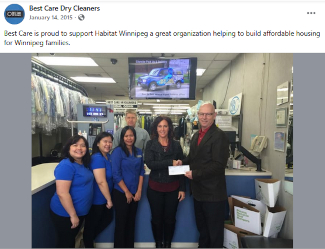
Even though the internet is a global platform, when it comes to a very local business like yours, tying yourself to things going on right at home will resonate with your customers and potential customers. You don’t have to try to put out posts that hold readers at arm’s length while you talk about big issues in fabricare. Go ahead and get personal!
Talk about the weather (that’s as local as it gets) and its impact on garments and their care. Focus on seasonal habits or events in the community that everyone knows about if they are from the area. Follow the rhythms of your community (school year, sports seasons, events) and link them into your messages.
Yours is a business that operates within a fairly confined local space. Show readers that you are not just in the community, but truly a part of it.
“Mud season is here. Let garments dry fully before bringing them in—it makes removal easier.”
People are the basis of trust
Service businesses like yours are based on personal relationships. Customers trust you with very intimate parts of their lives—their garments. They want to feel they’ve left them in safe hands, so help them get to know the people behind the care they receive.
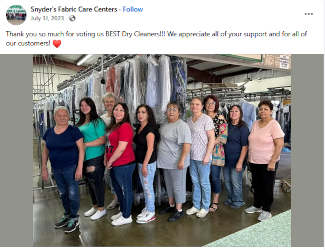
Tell staff stories in your posts. Show real hands (not generic, stock footage) doing real work. Use video of your plant. When people see these kinds of posts, they grow to trust what is happening in your plant. In addition, the platforms detect authenticity and boost your posts. AI needs to know there’s a real business behind the posts, and including staff and actual footage does that.
You don’t have to hire professional videographers to come in and make a slick video of everything in your plant. These days, it’s probably best if you don’t, as it can look fake. A hand-held phone camera will give you what you need, and those seeing the post will recognize it as authentic.
Repeat, repeat, repeat
When you consider making 1-3 posts a week, that means 50-150 posts per year! Suddenly, your idea well dries up and you are ready to toss the whole project because you don’t have 150 ideas. You don’t need anywhere near that many.
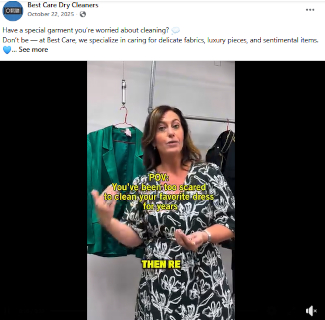
Sit down and brainstorm about 10 messages that you’d like to convey, and then write them as they would appear if you were educating, reassuring, explaining, reminding or humanizing on that topic. Suddenly, you have a whole stack of easy concepts to convey. Run the same idea over and over, but in different formats, or using different graphics and images. The messages are the same, but they look fresh every time you use them. Over time, they will build your credibility.
For instance, a cleaner explaining stain care multiple times over months is not boring—it establishes authority.
Educational posts, in particular, have long tails. They resurface all over the internet, get saved by readers, are quoted by others, and can be used as training references. When you create posts like these, it turns social media into an asset, not a chore.
Call to action
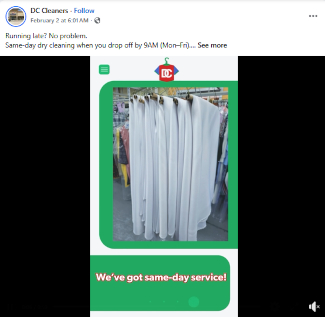
Hard calls to action (“Act today!”) actually suppress engagement on the part of the reader. They don’t like being pushed. A light and logical call to action is much more effective, especially in social media.
“If you have questions, just ask us.”
“Bring it in before washing.”
“We’re happy to take a look.”
These are less intimidating, and more conversational. You want your customers and potential customers to view you as a friend, not a bully.
Public memory
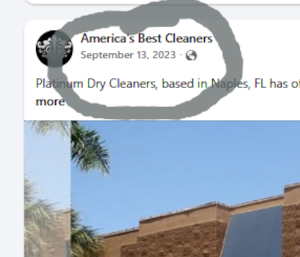
Social posts were viewed as fleeting bits of fluff on the internet. That has changed. Social media posts are now thought of as public memory. Posts are indexed. They’re searchable long after they were posted. They are scraped by AI looking for information for searchers. They are tagged and referenced for later.
Excellent posts are written as if they might be read months or years later—because they will be. Keep it in mind, and make every post count.
EDITOR’S NOTE:
Throughout this month we will be bringing you examples of companies that are doing a great job with their social media posts, so you can learn from the best. Stay tuned!
Related Posts


About The Author

Editor, Fabricare Canada magazine
Becca Anderson spent 17 years in public relations, advertising and corporate PR before joining Fabricare Canada in 2000. She was named editor in 2013, and welcomes feedback about the magazine via the contact form on this site.