
Behind the Tech: Inside the Milnor Factory
Series: Behind the Tech

If you’ve never been to a factory that produced the equipment you run every day, you’ve missed a treat. Pellerin-Milnor took us behind the scenes so you can get an idea of what goes into the indispensable equipment in a plant.
Help our readers visualize where their machines are born. When someone walks into your manufacturing plant for the first time, what usually surprises them most?
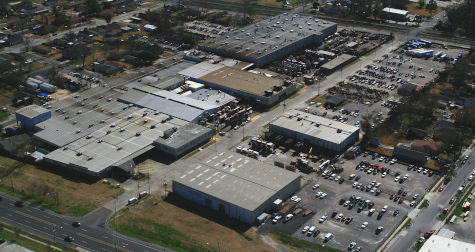
Most visitors are immediately struck by the sheer scale of our operation. Our facility spans 400,000 square feet (37,160 square metres).
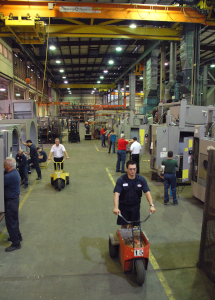
Another often surprising aspect of our plant is the vast array of manufacturing processes we conduct. The Milnor factory is not just an assembly line. We take raw material, including carbon and stainless sheet metal, and laser cut, stamp/press, bend/fold, weld, paint and polish it. We machine, drill and tap castings, as well as cut and pin our own wire harnesses and design our own electrical boards. Then we assemble, test, pack/crate and ship machines ranging from 40-pound (18 kg) capacity washer/extractors, to single-stage presses weighing up to 56,000 pounds (25,400 kg).
Visitors also have the opportunity to see our extensive spare parts inventory. Milnor has two separate physical inventories of parts. One is used for machinery manufacturing while the other is for end-user support. We maintain an extensive inventory of parts for machines we manufacture, even models that have been long discontinued. This commitment ensures reliable, long-term support for our customers.
What aspects of the manufacturing process are still hands-on, and where has automation made the biggest impact?
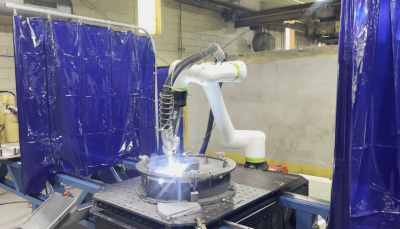
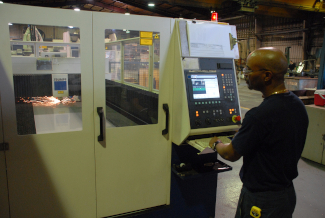
We incorporate a mix of manual, semi-automated and automated processes in our factory. Assembly is the most manual process. Welding is a combination of manual, cobot (human plus robot) and robot welding. Fabrication incorporates CNC (Computer Numerical Control) machine centres, multi-axis turning machines, mills, and a sheet metal laser cutting and storage automation system.
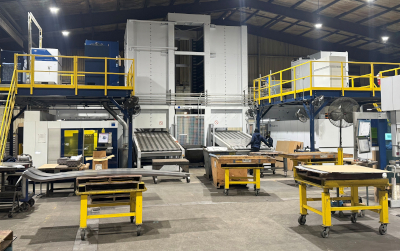
The laser and storage automation system has substantially improved efficiency by reducing labour, along with improving throughput and workflow.
How many different trades or specialties touch a machine before it ships?
Our workforce includes sheet metal workers, machinists, tool & die specialists, coatings, and welders.
Are there parts of the process that haven’t changed much in decades? Why do those endure?
While most of what we do has changed considerably over the years, the grind and polish department continues to operate as it did two decades ago. These jobs depend on a labour force that can blend craftsmanship and attention to detail to properly prepare a part or weldment to be aesthetically pleasing and functional for laundry processing.
What’s the single most complex step in building one of your machines?
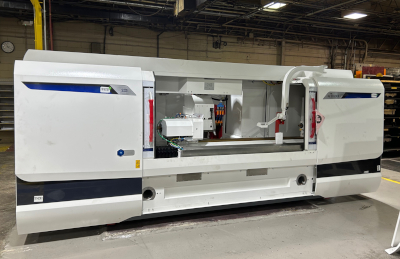
Within our shop we make many parts that require a combination of a highly skilled workforce and sophisticated equipment to produce a desired effect. For example, some parts stamped on our 800-ton mechanical press go through several stages and multiple dies changes to achieve a finished state. Others are fabricated through a combination of bending and rolling to create complex shapes.
How do you balance efficiency with craftsmanship on the factory floor?
Although we have many processes and systems to operate the factory efficiently, craftsmanship is simply embedded in our culture. Milnor has always been committed to producing the highest quality products in the industry.
Who are the people building these machines – what backgrounds do they come from?
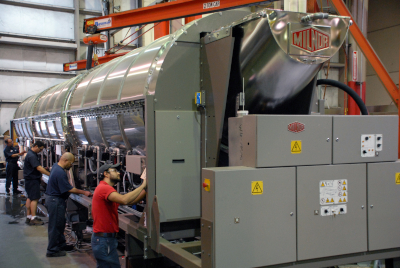
Milnor machines are built by a diverse and highly skilled workforce with deep roots in industrial manufacturing. Our team includes entry-level trainees who are developed through hands-on experience and mentoring, seasoned assemblers who have spent years refining their craft, and highly skilled specialists such as certified welders, CNC operators, electricians and test technicians.
Supporting the production floor is a dedicated group of mechanical, electrical, welding and industrial engineers. These engineers work closely with manufacturing to design robust machinery, refine processes, solve complex production challenges, and ensure every machine meets Milnor’s performance and durability standards.
Together, this blend of practical experience, technical expertise and engineering support allows Milnor to manufacture heavy-duty industrial machinery with consistency, precision and long-term reliability – qualities our customers have come to expect over decades of service.
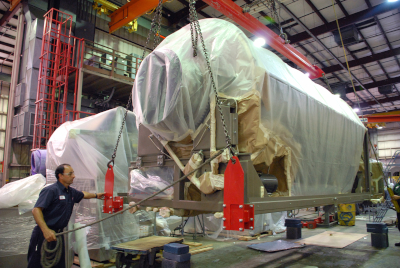
How long do your average production employees stay with the company?
A number of employees have 30, 40 and, in some cases, 50 years of service. At the same time, we continue to attract younger employees who value employment with a family-owned manufacturer that offers stability, skill development and long-term career opportunities.
What kind of training does it take before someone is trusted to assemble or calibrate a machine?
We have a well-defined structure for developing our factory workforce. Each job has multiple levels and each level has multiple steps. For example, an assembler position has four levels and each level has four steps. As the assembler builds skills and gains experience, they progress through the various grades.
Are there families or multiple generations working in your plant?
Yes. Milnor employs multiple family lines, with several generations represented within the workforce. As a family-owned company, this continuity aligns naturally with our operating culture.
Generational employment supports knowledge transfer, workforce stability, and consistency in manufacturing practices. Family members tend to demonstrate strong accountability and long-term commitment, contributing to operational reliability, and maintaining Milnor’s established standards for quality and performance.
What role does institutional memory play in your manufacturing process?
Institutional memory is valuable at Milnor, but it is intentionally captured and formalized through documentation rather than relying solely on individual experience. Core manufacturing data – including bills of material, routings and related production records – is managed within Oracle E-Business Suite to ensure consistency, accuracy and repeatability.
In parallel, Milnor maintains a comprehensive Technical Knowledge Base that converts institutional knowledge into documented, searchable information. This open-access database, available through our website without login credentials, contains technical support documents developed from years of manufacturing and field experience. The knowledge base is continuously expanded on, ensuring critical knowledge is preserved, searchable, and available to both internal teams and customers.
Is there a particular skill that’s especially hard to teach or replace?
Tool & die skills are the rarest and most difficult to train. This is a highly specialized job that requires many skills to cover the breadth and depth of the trade.
For more information, visit the website: https://www.milnor.com/
Related Posts


About The Author

Editor, Fabricare Canada magazine
Becca Anderson spent 17 years in public relations, advertising and corporate PR before joining Fabricare Canada in 2000. She was named editor in 2013, and welcomes feedback about the magazine via the contact form on this site.