Your Invisible Asset
How Chemistry is Strategy in Fabricare
By Becca Anderson

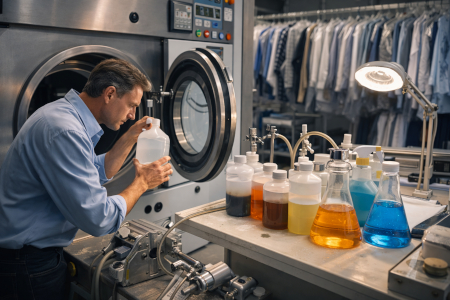
Every industry has a hidden side that makes all the difference to its success. For the fabricare industry, it’s the “liquid side” of your process—everything from solvents and detergents to spotting chemicals, bleaches, softeners, and water. All play an enormous role in the outcome of any given load of clothing or other textiles.
I call these hidden because the machines and the people get all the attention. Equipment upgrades make headlines. New presses, washers, dryers and automation systems are visible, tangible and impressive. But your chemistry arrives quietly. It shows up in drums, pails, cartridges and piping. Then it disappears into the process.
Yet chemistry is doing the heavy lifting. Every time a garment comes back clean, bright, soft, odor-free, and wearable, chemistry made that happen. And every time a garment comes back gray, stiff, smelly, misshapen, or still stained, chemistry was involved in that outcome as well—whether anyone noticed or not.
Because it is intertwined with the very fabric (pardon the pun) of your business’s success, every supply order becomes a strategic decision that can affect the quality of your work, the costs involved, customer satisfaction, regulatory compliance, and the long-term direction of your company.
Let’s examine this side of your business in more detail.
Cleaning is a system, not a product

One common misconception is that cleaning performance can be traced to a single choice. What solvent or detergent or brand do you use? But in reality, cleaning is a whole system.
None of the supplies you use work in isolation. Solvents and detergents are great, but they work in concert with a whole list of factors to deliver the result you hope for. And even the best chemistry will fail if it’s misapplied, applied in the wrong amounts, or paired with the wrong process.
On the other hand, average products can sometimes deliver excellent results when they are part of a well-managed and well-understood system. That system includes:
- The solvent or wash medium
- The detergent and additives
- Water control and chemistry balance
- Mechanical action
- Temperature and time
- Filtration, distillation, or rinsing
- Delivery or dosing accuracy
- Operator knowledge and consistency
If even one element is off, the whole system shifts. This explains why two plants using the same products and equipment can get very different results. It’s also why supply decisions deserve the same level of thought and planning as equipment purchases, and shouldn’t be based entirely on price.
What you use determines what happens
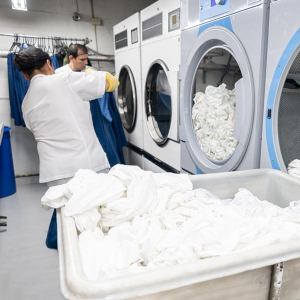
If “liquid” supplies are just a line on a spreadsheet to you, you’ve missed the real picture. These vital purchases determine the overall success of your entire company. Consider five areas where chemistry directly affects your business.
- Quality and Rework. Successful stain removal, optical brightness, fabric feel, odor control, and shape retention are all chemistry-dependent. Poor chemistry choices don’t just hurt quality; they increase re-cleans, handwork, and customer complaints.
- Cost Control. Overdosing, incompatibility, and poor delivery systems quietly waste money. On the flip side, well-matched chemistry and proper dosing often reduce water, energy, labor, and rewash costs—sometimes dramatically.
- Fabric Life. Aggressive or mismatched chemistry shortens garment life, weakens fibers, fades color, and damages trims. That doesn’t just affect customers; it affects your reputation.
- Compliance and Risk. Regulatory requirements, worker safety, environmental concerns, and waste handling are all tied to chemistry. The wrong choice can create headaches far beyond the plant floor.
- Customer Perception. Customers may never see your detergent, but they absolutely notice how their garments look, feel, and smell. Chemistry plays a central role in whether customers describe your work as “excellent” or “just okay.”
Different goals, different chemistry

Dry cleaning, wet cleaning, industrial laundry and laundromats have different customers and different goals. That means they also have different approaches to the chemical products they should be using.
For instance, dry cleaning chemistry focuses on soil suspension and preventing redeposition. Dye stability is key, and moisture management is vital.
Wet cleaning balances cleaning power with finishing control.
Industrial and commercial laundry plants prioritize soil type, sanitation, throughput, efficiency and consistency. Their customers have rigid expectations of not only how things are cleaned, but how they are packaged coming back to them for ease of distribution.
Finally, laundromats and wash-and-fold services are trying to balance performance, cost, safety and customer experience in ways that the other three don’t.
There is no single philosophy or formulation that fits all these environments. Understanding why chemistry differs across segments is the first stop toward making better decisions in your own operation.
Delivery matters

Even excellent chemistry fails when delivery is sloppy. Manual pouring, inconsistent measurement, and “eyeballing it” introduce variations that no formulation can overcome. This is why dosing, injection, and dispensing systems were invented and have become so central to modern garment care plants.
When you take out the human element, these systems bring accuracy to each load’s chemical mix. That results in improved consistency across shifts. It also reduces waste and exposure to chemicals for the operators. Using a dosing system simplifies training and makes troubleshooting possible, since there is something to go back to and evaluate what happened. Proper dosing also protects the garments and other textiles, and the equipment.
Automation isn’t about replacing people. It’s about supporting people, so that knowledge and best practices don’t disappear with staff turnover or busy days.
Suppliers as partners, not vendors
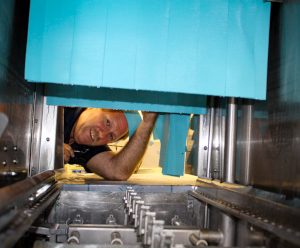
The difference between a partner and a vendor is that a vendor is someone who sells you something you order. You may buy it once or on an ongoing basis, but this person just fills the order. A partner, on the other hand, has a stake in your success, and wants to be sure you are getting exactly what you need to have the best possible outcomes.
If you are not treating your chemistry supplier(s) as partners, you’re missing out on a whole array of services and expertise that can make a huge difference for your plant. A good chemistry supplier has a deep understanding of soils, fabrics and formulations. They’ll also have process knowledge across many operations, and can help you find new and better ways to do things. They offer training and troubleshooting expertise. They also keep up with changing regulations and garment needs or trends that will impact your business.
Used well, a supplier-partner becomes an extension of your operation. If you just treat them as a vendor, you miss a great opportunity.
What’s your strategy?
EDITOR’S NOTE: Throughout this month we’ll be diving in to specific areas of the liquid side of garment care, such as solvents, detergents, spotting agents, wet cleaning systems, industrial laundry formulations, laundromat chemistry, and the technology that delivers it all. Stay tuned for more!
Related Posts


About The Author

Editor, Fabricare Canada magazine
Becca Anderson spent 17 years in public relations, advertising and corporate PR before joining Fabricare Canada in 2000. She was named editor in 2013, and welcomes feedback about the magazine via the contact form on this site.